

March 12, 2026
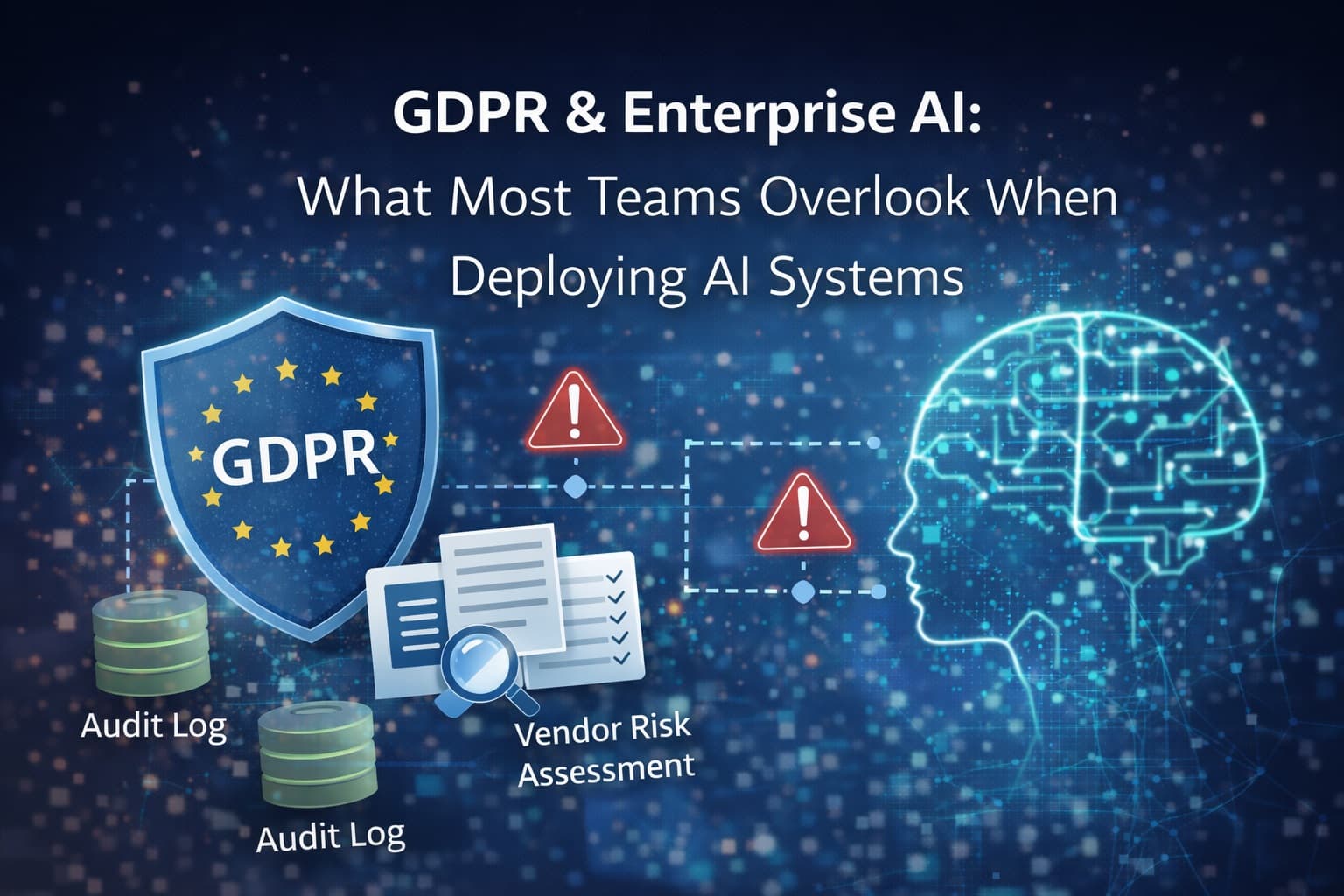
GDPR & Enterprise AI: What Most Teams Overlook When Deploying AI Systems
Learn what enterprise teams often overlook when deploying AI under GDPR, including transparency requirements, logging obligations, access control, and vendor risk.
Enterprise AI adoption is accelerating rapidly. Organizations are integrating AI assistants, knowledge search systems, and intelligent automation into daily workflows to improve productivity and decision-making.
However, while teams often focus on model performance and integration capabilities, GDPR compliance is frequently treated as an afterthought.
This oversight can create serious risks.
Enterprise AI systems process vast amounts of internal knowledge, documents, and operational data. Without proper governance, organizations may unintentionally violate data processing transparency requirements, logging obligations, access controls, or vendor risk policies.
This article explains what enterprise teams often overlook when deploying AI systems under GDPR and how organizations can design AI architectures that remain compliant while still delivering business value.
Why GDPR Matters for Enterprise AI Systems
The General Data Protection Regulation (GDPR) is one of the world’s most comprehensive data protection frameworks. Although it was introduced before the current wave of generative AI systems, its principles directly apply to enterprise AI deployments.
GDPR focuses on several core principles relevant to AI systems:
- Lawful and transparent data processing
- Purpose limitation and data minimization
- Security and access control
- Accountability and auditability
These principles are especially important when organizations deploy AI search platforms, enterprise chatbots, or AI agents that interact with internal knowledge bases.

Organizations that fail to implement governance mechanisms risk violating regulatory expectations outlined by authorities such as the European Data Protection Board (EDPB) and the UK Information Commissioner’s Office AI guidance.
The Hidden Compliance Risks in Enterprise AI Deployments
Enterprise AI systems often introduce new types of data flows that traditional IT governance frameworks were not designed to manage.
Some common risks include:
- AI models accessing data beyond user permissions
- Lack of audit logs for AI-generated responses
- Insufficient transparency around how AI processes information
- Third-party AI vendors accessing sensitive data
These risks are particularly relevant for organizations deploying AI-driven enterprise search or conversational assistants.
Without the right controls, AI systems can inadvertently surface restricted or sensitive information, creating compliance and governance issues.
Data Processing Transparency: A Core GDPR Requirement
One of the fundamental GDPR principles is transparency in data processing.
Organizations must be able to explain:
- What data is processed
- Why it is processed
- How it is used by automated systems
For enterprise AI platforms, this means clearly documenting how AI systems interact with internal knowledge sources. For example:
AI Function | Required Transparency |
|---|---|
AI search systems | Which data sources are indexed |
Enterprise chatbots | What knowledge base is used |
AI agents | What systems they access |
Analytics dashboards | How user interactions are logged |
Transparency also ensures that organizations can respond to inquiries from regulators referencing guidance such as the EU GDPR Article 5 principles.
Logging and Auditability in Enterprise AI Systems
Another area that organizations often overlook is logging.
GDPR accountability requirements mean organizations must maintain records of how data is processed.
In AI systems, this includes:
- Query logs
- Retrieval records
- Generated responses
- Access requests
Without proper logging, organizations cannot demonstrate compliance during an audit.

Logging helps organizations answer important questions:
- Which data sources were accessed?
- Who initiated the query?
- What information was retrieved?
- What response was generated?
Regulatory bodies such as NIST AI Risk Management Framework emphasize the importance of traceability and monitoring in AI systems.
Role-Based Access Control: Preventing Unauthorized Data Exposure
One of the biggest risks in enterprise AI systems is data leakage caused by insufficient access controls.
Traditional search tools typically enforce permission boundaries, but AI systems must ensure these controls remain intact when generating responses.
This is where role-based access control (RBAC) becomes critical.
AI systems should ensure:
- Users only access data they are authorized to see
- AI retrieval layers respect document permissions
- Generated responses do not expose restricted information
Security Control | Purpose |
|---|---|
Role-based access control | Restrict AI responses based on user permissions |
Retrieval filtering | Prevent unauthorized document access |
Identity integration | Align AI permissions with enterprise identity systems |
These measures align with best practices recommended by organizations such as the European Union Agency for Cybersecurity (ENISA).
Vendor Risk in the Enterprise AI Supply Chain
Another area many organizations underestimate is vendor risk.
Enterprise AI systems often rely on external providers for:
- AI models
- hosting infrastructure
- analytics services
- integrations
Each vendor introduces potential compliance implications.
Organizations must evaluate questions such as:
- Does the vendor store customer data?
- Is the AI system trained on enterprise data?
- Where is the data processed geographically?
- What contractual protections exist?
These considerations are especially important when working with AI infrastructure vendors, as emphasized in guidance from the OECD Principles on Trustworthy AI.

What Enterprise Buyers Should Evaluate Before Deploying AI
Enterprise decision-makers should assess several factors before deploying AI systems.
Governance Checklist
Evaluation Area | Key Questions |
|---|---|
Data transparency | Can the system explain how data is processed? |
Logging | Are AI interactions recorded for auditing? |
Access control | Does the system enforce RBAC? |
Vendor risk | Are third-party providers compliant? |
Deployment flexibility | Can the system run in controlled environments? |
Deployment flexibility is particularly important for organizations that require controlled environments such as private cloud or VPC deployments.
How SparkVerse AI Supports GDPR-Ready Enterprise AI
SparkVerse AI develops enterprise AI infrastructure designed to support both innovation and compliance.
Its solutions help organizations deploy AI while maintaining governance controls aligned with regulatory expectations.
Key capabilities include:
- Secure knowledge retrieval systems through SparkVerse AI Search
- Conversational enterprise assistants via SparkVerse AI Chatbots
- Intelligent workflow automation through SparkVerse AI Agents
- Observability through SparkVerse Analytics Dashboards
- Flexible infrastructure via SparkVerse Secure Hybrid Deployments
These capabilities support enterprise requirements such as:
- Role-based access control
- Comprehensive audit logging
- Encryption and secure data handling
- Flexible SaaS or VPC deployment options
By integrating governance into the AI architecture itself, organizations can deploy AI systems with greater confidence.
The Future of Enterprise AI Will Be Governance-Driven
Enterprise AI adoption will continue to grow, but compliance and governance will increasingly shape how systems are deployed.
Organizations that treat governance as an afterthought may encounter operational risks, regulatory scrutiny, or reputational damage.
Instead, successful enterprises will build AI architectures where security, transparency, and accountability are embedded from the beginning.
Frameworks from organizations such as the NIST AI Risk Management Framework and the European Commission AI governance guidance highlight the growing importance of responsible AI deployment.
Final Thoughts
Enterprise AI is transforming how organizations access knowledge, automate processes, and support decision-making.
But with these capabilities comes responsibility.
Teams that overlook transparency, logging, access control, and vendor risk may face avoidable compliance challenges.
By designing AI systems with governance in mind; and leveraging platforms such as SparkVerse AI, organizations can unlock the benefits of enterprise AI while maintaining the trust and accountability required in today’s regulatory environment.

Written By